CPU Caches
See Memory Hierarchy .
Caches data from main memory. There are also special Instruction Caches to cache memory containing instructions. See also: Cache Optimizations
Reasons to caching #
- Temporal locality
- (The same) addresses recenctly accessed will probably be accessed again in the future
- Spatial locality
- Addresses near recently accessed addresses will probably also be accessed in the near future
Implementations of caches #
Fully assiciative cache #
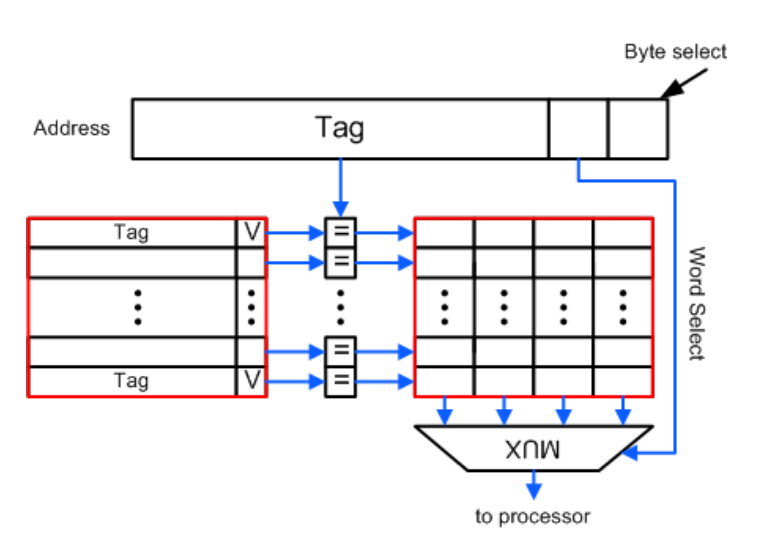
- The address is split up in a “Tag” and word- and byte-select
- Each cacheline is able to store all memory lines (alignment applies of course)
- Each cacheline has to be checked for the tag in parallel -> expensive / hard / slow
Direct mapped cache #
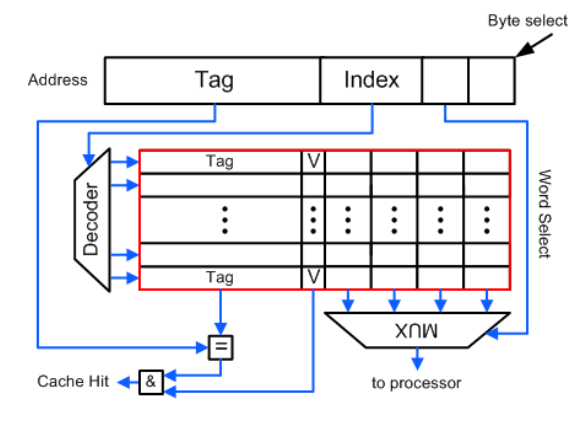
-
The address is split into Tag, index, word- and byte-select
-
A decoder determines the unique cacheline for that index -> Super fast access
-> if unlucky, accesses to frequent data keep colliding in the same cache line and cannot be held both in the cache
Set-associative cache #
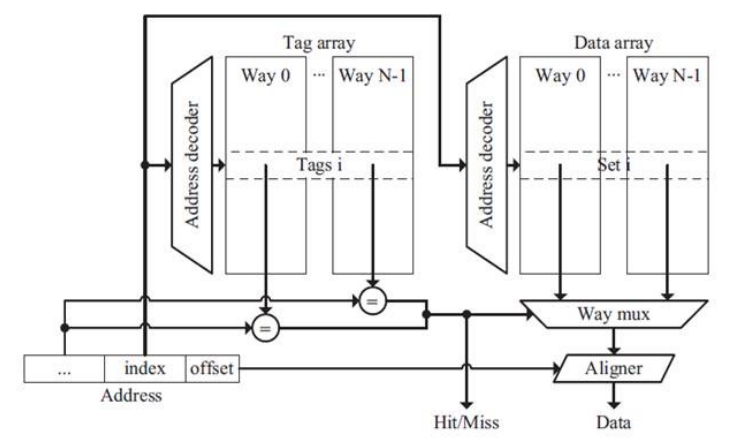
- Have multiple direct mapped chaches that are associative to another, only limited number of cache lines have to be checked.
Cache update stategies #
Write through cache #
-
Every write to the cache is directly propagated to higher levels
-
higher bus bandwidth
-
On write miss:
- Write Allocation: Fetch first then write trough
- No Write allocation: no action in the cache
Write back cache #
- Modifications are stroed in the cache and only propagated to memory if cache line is evicted
- Uses dirty bit per cache line
- Reduce bus traffic
Cache Replacement stategies #
- Which cache line to evict?
- Random: .. yeah
- LRU: theoretically goof, but hard to implement in hardware
- FIFO: somehow based on temporal locality
Reasons of Cache Misses #
- Cold miss
- Access of data that was never in cache before (nothing can be done to prevent this)
- Capacity miss
- Memory block was in cache before but had to be evicted due to limited cache size (can be improved with bigger caches)
- Conflict miss
- Memory block was in cache before but had to be evicted due to conflict (like in a direct mapped cache)
Blocking vs Non-Blocking Cache #
A blocking cache stalls on a miss until the data arrives from higher level cache.
Non blocking caches can still serve memory accesses while another load is waiting for the data.
For non-blocking caches, additional components are necessary:
- Miss Status/information Holding Registers (MSHRs)
- Store information about pending misses.
- Fill Buffer
- Holds fetched data before they are written to the data array
Categories of Cache misses (for non blocking caches) #
- Primary miss
- the first time a miss occurrs to a memory block
- Secondary miss
- subsequent misses to the same memory block while the data is still being fetched
- Structural-stall miss
- a secondary miss that the availiable hardware resources cannot handle
MSHR: implicit #
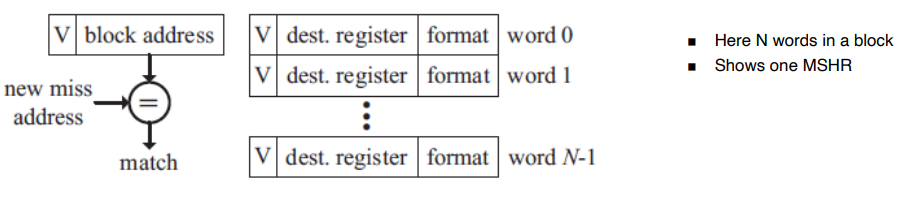
- Each MSHR field stores the offset in the cache line
- multiple outstanding misses for the same word cannot be stored -> only one entry per address possible
MSHR: explicit #
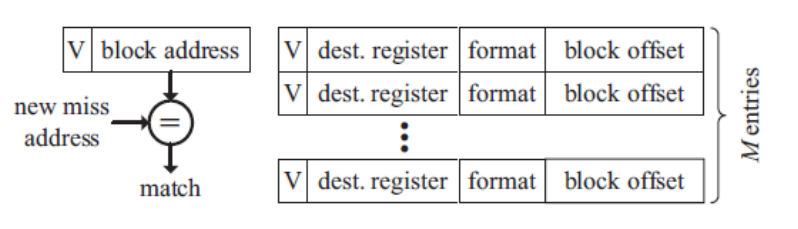
- Each MSHR field stores the offset in the cache line
- multiple outstanding misses for the same word can be stored
MSHR: in-cache #
- Reuse the cache line to store info about pending misses
- Extra bit: “Transient bit” to distinguish from data in cache