Instruction Set Architecture
- “Interface from the programmer to the processor”
- Processors are binary compatible if they support the same ISA
Data Types and formats #
- Integer types
- Fixed / Floating point types
- String formats
- …
Operands #
-
Number of operands (0, 1, 2, 3)
-
Types of operands
- Immediate operands (part of the instruction)
- Register operands (content of the register is the operand)
- Memory operands (content of a memory address is the operand)
-
Alignment of operands
- Memory operand is aligned at a n-bit boundary if the address is a multiple of n
- Usually memory operands have to be aligned according to their own size
- Can be required by the ISA to only access size-aligned data
-> Needed for cache lines: If cach lines are
 byte sized and
aligned, for a reasonably large
byte sized and
aligned, for a reasonably large  , then smaller data will always fit
in a cache line if it is also aligned.
, then smaller data will always fit
in a cache line if it is also aligned.
Addressing modes #
- Immediate operands (part of the instruction)
- Register operands (content of the register is the operand)
- Direct (memory address is part of the instruction)
- Only if you know the address of a constant or something in the data segment
- Register indirect: (memory address is in a register)
- Indexed: (register indirect plus fixed offset)
- Can be used for PC-relative jumps (maybe for jump tables like for
switchstatements?)
- Can be used for PC-relative jumps (maybe for jump tables like for
Classes of Instructions #
- data transfer
- arithmetic and logic operations
- control flow: calls, jumps, …
- I/O instructions
- System level instructions: interrupts, stack, priviledge level
Instruction format #
- structure of opcode and operands
- either single format for all instructions (Von Neumann Architecture )
- or more flexible ones (complex decoding)
- (NOTE: instruction size depends on operand types (registers really small, memory address much bigger))
Registers #
-
Memory in the processor
-
Fast access (fastest access)
-
Types:
- General registers: interges, addesses
- Floating point registers
- Special refisters: multimedia, loop control register, …
- System registers: program counter, status, control register
-
Only few registers defined by ISA to keep names as short as possible
-
Register file = set of (same type) registers
-
Sliding window register file:
- Attempt to have a lot of registers, but still have instuction length short:
- Have a “Window” you can move over the full register file. All register access then only acts on the active window
- Special operations to slide the window of addresses over the real registers
- Attempt to have a lot of registers, but still have instuction length short:
Execution Modes #
-
Motivation: Applications and data need to be protected from other running programs
-
OS manages hardware -> Assigns memory ranges to processes
-
Two execution modes:
- Supervisor mode:
- Reserved for OS
- Full access to all components
- Can modyfiy virtual address table
- User mode:
- Limited access
- Access to memory only through memory translations (Virtual address space)
- No priviledged instruction for I/O or accerss to control registers
- Supervisor mode:
Exception Handling #
-
Exception (Interrupt) triggered by the program
- Executing a priviledged instruction in user mode
- Division by Zero
- Access virtual page with wrong permissions
-
Exception handled by the OS:
- Interrupt the currently executed instruction
- save processor state (all registers and immediate values)
- jump to handler for the exception
- switch to supervisor mode
- handle the exception
- return to original instruction in user mode
-
Precise exceptions:
- Assume all previous instructions are complete
- Assume no future instructions have been exectuted
- Assumes no piplining
-
Imprecise exceptions:
- Exceptions can happen out of order
CISC vs RISC #
- CISC
- Complex instruction set architecture
-
variable instuction format
-
Instructions can have prefixes
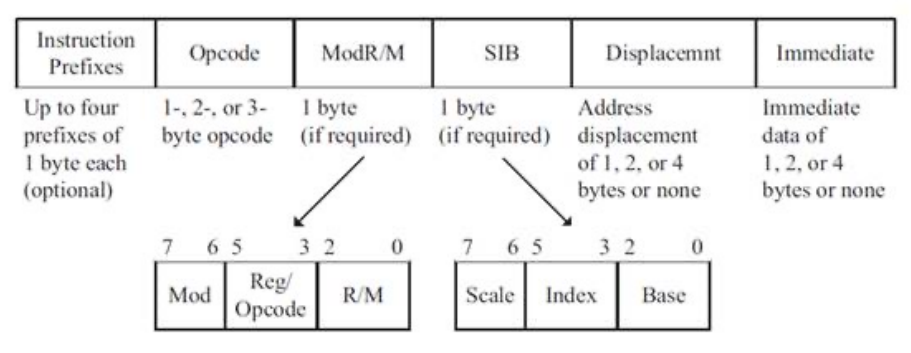
- Opcode can start in the first 5 bytes
-
memory and register operands
-
specialized instuctions
-
- RISC
- Complex instruction set architecture
- single instruction format (fetch / decode simpler)
- load/store architecture
- limited addressing modes
- one cycle machine instructions
Comparison - CISC leads to shorter programs - CISC is more flexible - RISC is faster - RISC needs to emulate more complex instuctions
Endianness #
- Order of the bytes
- least significant byte first
- most significant byte first