DeepSDF
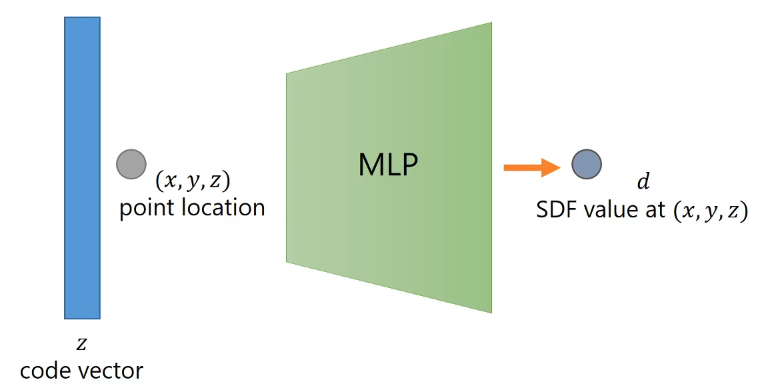
- DeepSDF is an auto-decoder based approach that learns a continuous SDF
representation for a class of shapes. Once trained, it can be used for
- shape representation
- interpolation
- shape completion
Bibtex #
@inproceedings{park2019deepsdf,
  title={Deepsdf: Learning continuous signed distance functions for shape
         representation},
  author={Park, Jeong Joon and Florence, Peter and Straub, Julian and Newcombe,
          Richard and Lovegrove, Steven},
  booktitle={Proceedings of the IEEE/CVF Conference on Computer Vision and
             Pattern Recognition},
  pages={165--174},
  year={2019}
}
Overview #
- Not tied to a grid structure
- During training, the autodecoder optimizes both the network parameters and the latent codes representing each of the training shapes. Once trained, to reconstruct a shape given its SDF observations, a latent code is optimized keeping the network parameters fixed, such that the optimized latent code gives the lowest error with observed SDF values.
Architecture #
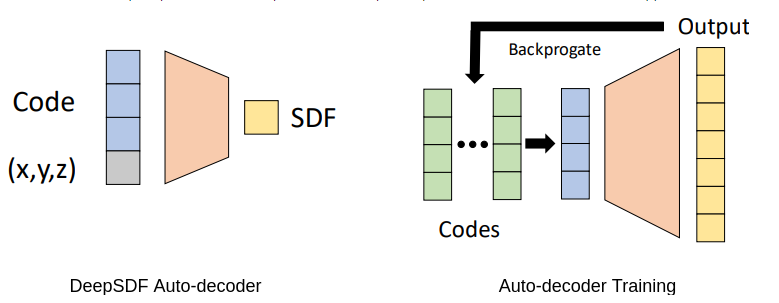
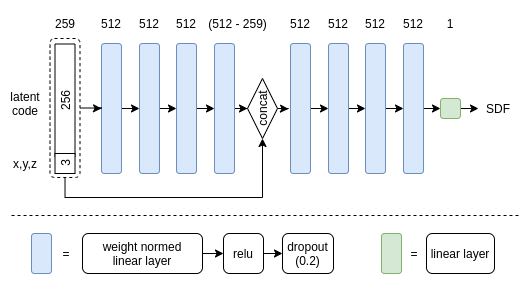
Figure 1: Architecture of the Auto-decoder
Implementation #
Model #
import torch.nn as nn
import torch


class DeepSDFDecoder(nn.Module):

    def __init__(self, latent_size):
        """
        :param latent_size: latent code vector length
        """
        super().__init__()
        dropout_prob = 0.2

        # NOTE: Define model
        self.lin0 = nn.utils.weight_norm(nn.Linear(259,  512))
        self.lin1 = nn.utils.weight_norm(nn.Linear(512,  512))
        self.lin2 = nn.utils.weight_norm(nn.Linear(512,  512))
        self.lin3 = nn.utils.weight_norm(nn.Linear(512,  (512 - 259)))

        self.lin4 = nn.utils.weight_norm(nn.Linear(512,  512))
        self.lin5 = nn.utils.weight_norm(nn.Linear(512,  512))
        self.lin6 = nn.utils.weight_norm(nn.Linear(512,  512))
        self.lin7 = nn.utils.weight_norm(nn.Linear(512,  512))

        self.lin8 = nn.Linear(512, 1)

        self.relu    = nn.ReLU()
        self.dropout = nn.Dropout(dropout_prob)


    def forward(self, x_in):
        """
        :param x_in: B x (latent_size + 3) tensor
        :return: B x 1 tensor
        """
        # NOTE: implement forward pass

        x = self.lin0(x_in)
        x = self.relu(x)
        x = self.dropout(x)

        x = self.lin1(x)
        x = self.relu(x)
        x = self.dropout(x)

        x = self.lin2(x)
        x = self.relu(x)
        x = self.dropout(x)

        x = self.lin3(x)
        x = self.relu(x)
        x = self.dropout(x)

        x = torch.cat((x, x_in), dim=1)

        x = self.lin4(x)
        x = self.relu(x)
        x = self.dropout(x)

        x = self.lin5(x)
        x = self.relu(x)
        x = self.dropout(x)

        x = self.lin6(x)
        x = self.relu(x)
        x = self.dropout(x)

        x = self.lin7(x)
        x = self.relu(x)
        x = self.dropout(x)

        x = self.lin8(x)

        return x
Inference #
import random
from pathlib import Path

import torch
import numpy as np

from exercise_3.data.shape_implicit import ShapeImplicit
from exercise_3.model.deepsdf import DeepSDFDecoder
from exercise_3.util.misc import evaluate_model_on_grid


class InferenceHandlerDeepSDF:

    def __init__(self, latent_code_length, experiment, device):
        """
        :param latent_code_length: latent code length for the trained DeepSDF model
        :param experiment: path to experiment folder for the trained model; should contain "model_best.ckpt" and "latent_best.ckpt"
        :param device: torch device where inference is run
        """
        self.latent_code_length = latent_code_length
        self.experiment = Path(experiment)
        self.device = device
        self.truncation_distance = 0.01
        self.num_samples = 4096

    def get_model(self):
        """
        :return: trained deep sdf model loaded from disk
        """
        model = DeepSDFDecoder(self.latent_code_length)
        model.load_state_dict(torch.load(self.experiment / "model_best.ckpt", map_location='cpu'))
        model.eval()
        model.to(self.device)
        return model

    def get_latent_codes(self):
        """
        :return: latent codes which were optimized during training
        """
        latent_codes = torch.nn.Embedding.from_pretrained(torch.load(self.experiment / "latent_best.ckpt", map_location='cpu')['weight'])
        latent_codes.to(self.device)
        return latent_codes

    def reconstruct(self, points, sdf, num_optimization_iters):
        """
        Reconstructs by optimizing a latent code that best represents the input sdf observations
        :param points: all observed points for the shape which needs to be reconstructed
        :param sdf: all observed sdf values corresponding to the points
        :param num_optimization_iters: optimization is performed for this many number of iterations
        :return: tuple with mesh representations of the reconstruction
        """

        model = self.get_model()

        # NOTE: define loss criterion for optimization
        loss_l1 = torch.nn.L1Loss()

        # initialize the latent vector that will be optimized
        latent = torch.ones(1, self.latent_code_length).normal_(mean=0, std=0.01).to(self.device)
        latent.requires_grad = True

        # NOTE: create optimizer on latent, use a learning rate of 0.005
        optimizer = torch.optim.Adam(model.parameters(), lr=0.005)

        for iter_idx in range(num_optimization_iters):
            # NOTE: zero out gradients
            optimizer.zero_grad()

            # NOTE: sample a random batch from the observations, batch size =
            # self.num_samples
            batch_indices = np.random.choice(points.shape[0], self.num_samples)

            batch_points = points[batch_indices, :]
            batch_sdf = sdf[batch_indices, :]

            # move batch to device
            batch_points = batch_points.to(self.device)
            batch_sdf = batch_sdf.to(self.device)

            # same latent code is used per point, therefore expand it to have same length as batch points
            latent_codes = latent.expand(self.num_samples, -1)

            # NOTE: forward pass with latent_codes and batch_points
            nn_input = torch.cat((latent_codes, batch_points), dim=1)
            predicted_sdf = model(nn_input)

            # NOTE: truncate predicted sdf between -0.1, 0.1
            predicted_sdf = torch.clip(predicted_sdf, -0.1, 0.1)

            # compute loss wrt to observed sdf
            loss = loss_l1(predicted_sdf, batch_sdf)

            # regularize latent code
            loss += 1e-4 * torch.mean(latent.pow(2))

            # NOTE: backwards and step
            loss.backward()
            optimizer.step()

            # loss logging
            if iter_idx % 50 == 0:
                print(f'[{iter_idx:05d}] optim_loss: {loss.cpu().item():.6f}')

        print('Optimization complete.')

        # visualize the reconstructed shape
        vertices, faces = evaluate_model_on_grid(model, latent.squeeze(0), self.device, 64, None)
        return vertices, faces

    def interpolate(self, shape_0_id, shape_1_id, num_interpolation_steps):
        """
        Interpolates latent codes between provided shapes and exports the intermediate reconstructions
        :param shape_0_id: first shape identifier
        :param shape_1_id: second shape identifier
        :param num_interpolation_steps: number of intermediate interpolated points
        :return: None, saves the interpolated shapes to disk
        """

        # get saved model and latent codes
        model = self.get_model()
        train_latent_codes = self.get_latent_codes()

        # get indices of shape_ids latent codes
        train_items = ShapeImplicit(4096, "train").items
        latent_code_indices = torch.LongTensor([train_items.index(shape_0_id), train_items.index(shape_1_id)]).to(self.device)

        # get latent codes for provided shape ids
        latent_codes = train_latent_codes(latent_code_indices)


        for i in range(0, num_interpolation_steps + 1):
            # NOTE: interpolate the latent codes: latent_codes[0, :] and latent_codes[1, :]
            t = i / num_interpolation_steps
            interpolated_code = (1-t) * latent_codes[0, :] + t * latent_codes[1, :]
            # reconstruct the shape at the interpolated latent code
            evaluate_model_on_grid(model, interpolated_code, self.device, 64, self.experiment / "interpolation" / f"{i:05d}_000.obj")

    def infer_from_latent_code(self, latent_code_index):
        """
        Reconstruct shape from a given latent code index
        :param latent_code_index: shape index for a shape in the train set for which reconstruction is performed
        :return: tuple with mesh representations of the reconstruction
        """

        # get saved model and latent codes
        model = self.get_model()
        train_latent_codes = self.get_latent_codes()

        # get latent code at given index
        latent_code_indices = torch.LongTensor([latent_code_index]).to(self.device)
        latent_codes = train_latent_codes(latent_code_indices)

        # reconstruct the shape at latent code
        vertices, faces = evaluate_model_on_grid(model, latent_codes[0], self.device, 64, None)

        return vertices, faces
Training #
from pathlib import Path

import torch

from exercise_3.model.deepsdf import DeepSDFDecoder
from exercise_3.data.shape_implicit import ShapeImplicit
from exercise_3.util.misc import evaluate_model_on_grid


def train(model, latent_vectors, train_dataloader, device, config):

    # Declare loss and move to device
    # NOTE: declare loss as `loss_criterion`
    loss_criterion = torch.nn.L1Loss()
    loss_criterion.to(device)

    # declare optimizer
    optimizer = torch.optim.Adam([
        {
            # NOTE: optimizer params and learning rate for model (lr provided in config)
            "params" : model.parameters(),
            "lr"     : config["learning_rate_model"],
        },
        {
            # NOTE: optimizer params and learning rate for latent code (lr provided in config)
            "params": latent_vectors.parameters(),
            "lr"    : config["learning_rate_code"],
        }
    ])

    # declare learning rate scheduler
    scheduler = torch.optim.lr_scheduler.StepLR(optimizer, step_size=500, gamma=0.5)

    # Set model to train
    model.train()

    # Keep track of running average of train loss for printing
    train_loss_running = 0.

    # Keep track of best training loss for saving the model
    best_loss = float('inf')

    for epoch in range(config['max_epochs']):

        for batch_idx, batch in enumerate(train_dataloader):
            # Move batch to device
            ShapeImplicit.move_batch_to_device(batch, device)

            # NOTE: Zero out previously accumulated gradients
            optimizer.zero_grad()

            # calculate number of samples per batch (= number of shapes in batch * number of points per shape)
            num_points_per_batch = batch['points'].shape[0] * batch['points'].shape[1]

            # get latent codes corresponding to batch shapes
            # expand so that we have an appropriate latent vector per sdf sample
            batch_latent_vectors = latent_vectors(batch['indices']).unsqueeze(1).expand(-1, batch['points'].shape[1], -1)
            batch_latent_vectors = batch_latent_vectors.reshape((num_points_per_batch, config['latent_code_length']))

            # reshape points and sdf for forward pass
            points = batch['points'].reshape((num_points_per_batch, 3))
            sdf = batch['sdf'].reshape((num_points_per_batch, 1))


            # NOTE: perform forward pass
            nn_input = torch.cat((batch_latent_vectors, points), dim=1)
            predicted_sdf = model(nn_input)

            # NOTE: truncate predicted sdf between -0.1 and 0.1
            predicted_sdf = torch.clip(predicted_sdf, -0.1, 0.1)

            # compute loss
            loss = loss_criterion(predicted_sdf, sdf)

            # regularize latent codes
            code_regularization = torch.mean(torch.norm(batch_latent_vectors, dim=1)) * config['lambda_code_regularization']
            if epoch > 100:
                loss = loss + code_regularization

            # NOTE: backward
            loss.backward()

            # NOTE: update network parameters
            optimizer.step()

            # loss logging
            train_loss_running += loss.item()
            iteration = epoch * len(train_dataloader) + batch_idx

            if iteration % config['print_every_n'] == (config['print_every_n'] - 1):
                train_loss = train_loss_running / config["print_every_n"]
                print(f'[{epoch:03d}/{batch_idx:05d}] train_loss: {train_loss:.6f}')

                # save best train model and latent codes
                if train_loss < best_loss:
                    torch.save(model.state_dict(), f'exercise_3/runs/{config["experiment_name"]}/model_best.ckpt')
                    torch.save(latent_vectors.state_dict(), f'exercise_3/runs/{config["experiment_name"]}/latent_best.ckpt')
                    best_loss = train_loss

                train_loss_running = 0.

            # visualize first 5 training shape reconstructions from latent codes
            if iteration % config['visualize_every_n'] == (config['visualize_every_n'] - 1):
                # Set model to eval
                model.eval()
                latent_vectors_for_vis = latent_vectors(torch.LongTensor(range(min(5, latent_vectors.num_embeddings))).to(device))
                for latent_idx in range(latent_vectors_for_vis.shape[0]):
                    # create mesh and save to disk
                    evaluate_model_on_grid(model, latent_vectors_for_vis[latent_idx, :], device, 64, f'exercise_3/runs/{config["experiment_name"]}/meshes/{iteration:05d}_{latent_idx:03d}.obj')
                # set model back to train
                model.train()

        # lr scheduler update
        scheduler.step()


def main(config):
    """
    Function for training DeepSDF
    :param config: configuration for training - has the following keys
                   'experiment_name': name of the experiment, checkpoint will be saved to folder "exercise_2/runs/<experiment_name>"
                   'device': device on which model is trained, e.g. 'cpu' or 'cuda:0'
                   'num_sample_points': number of sdf samples per shape while training
                   'latent_code_length': length of deepsdf latent vector
                   'batch_size': batch size for training and validation dataloaders
                   'resume_ckpt': None if training from scratch, otherwise path to checkpoint (saved weights)
                   'learning_rate_model': learning rate of model optimizer
                   'learning_rate_code': learning rate of latent code optimizer
                   'lambda_code_regularization': latent code regularization loss coefficient
                   'max_epochs': total number of epochs after which training should stop
                   'print_every_n': print train loss every n iterations
                   'visualize_every_n': visualize some training shapes every n iterations
                   'is_overfit': if the training is done on a small subset of data specified in exercise_2/split/overfit.txt,
                                 train and validation done on the same set, so error close to 0 means a good overfit. Useful for debugging.
    """

    # declare device
    device = torch.device('cpu')
    if torch.cuda.is_available() and config['device'].startswith('cuda'):
        device = torch.device(config['device'])
        print('Using device:', config['device'])
    else:
        print('Using CPU')

    # create dataloaders
    train_dataset = ShapeImplicit(config['num_sample_points'], 'train' if not config['is_overfit'] else 'overfit')
    train_dataloader = torch.utils.data.DataLoader(
        train_dataset,   # Datasets return data one sample at a time; Dataloaders use them and aggregate samples into batches
        batch_size=config['batch_size'],   # The size of batches is defined here
        shuffle=True,    # Shuffling the order of samples is useful during training to prevent that the network learns to depend on the order of the input data
        num_workers=0,   # Data is usually loaded in parallel by num_workers
        pin_memory=True  # This is an implementation detail to speed up data uploading to the GPU
    )

    # Instantiate model
    model = DeepSDFDecoder(config['latent_code_length'])
    # Instantiate latent vectors for each training shape
    latent_vectors = torch.nn.Embedding(len(train_dataset), config['latent_code_length'], max_norm=1.0)

    # Load model if resuming from checkpoint
    if config['resume_ckpt'] is not None:
        model.load_state_dict(torch.load(config['resume_ckpt'] + "_model.ckpt", map_location='cpu'))
        latent_vectors = torch.nn.Embedding.from_pretrained(torch.load(config['resume_ckpt'] + "_latent.ckpt", map_location='cpu'))

    # Move model to specified device
    model.to(device)
    latent_vectors.to(device)

    # Create folder for saving checkpoints
    Path(f'exercise_3/runs/{config["experiment_name"]}').mkdir(exist_ok=True, parents=True)

    # Start training
    train(model, latent_vectors, train_dataloader, device, config)