Bilateral Filter
http://www.super.tka4.org/materials/lib/Articles-Books/Filters/Bilateral/tomasi98bilateral.pdf
An image filter that attmepts to keep edges sharp by weighting th contribution if each pixel in the filter footprint by the similarity with the to-be-filtered pixel.

Where  is the total mount of weight used for this pixel:

 is the image at position
 is the pdf for pixel similarity (can be gaussian)
 is the pdf for pixel distance (can be gaussian)
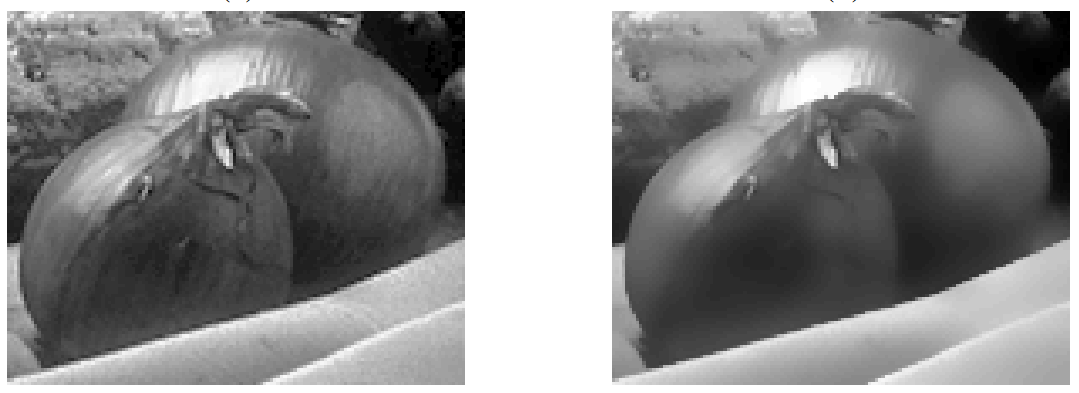
Paper #
@inproceedings{tomasi1998bilateral,
  title={Bilateral filtering for gray and color images},
  author={Tomasi, Carlo and Manduchi, Roberto},
  booktitle={Sixth international conference on computer vision (IEEE Cat. No. 98CH36271)},
  pages={839--846},
  year={1998},
  organization={IEEE}
}
Drawbacks #
Staircasing effect #
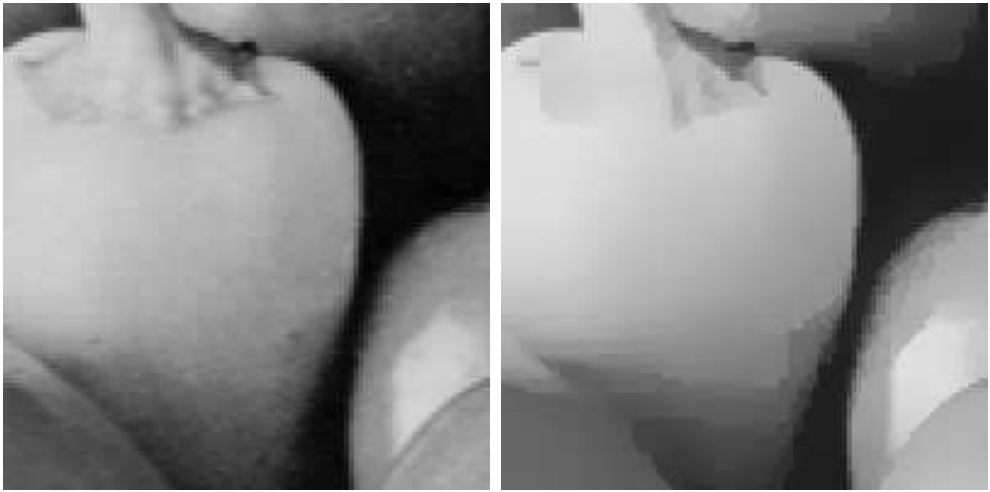
taken from:
@article{buades2006staircasing,
  title={The staircasing effect in neighborhood filters and its solution},
  author={Buades, Antoni and Coll, Bartomeu and Morel, J-M},
  journal={IEEE transactions on Image Processing},
  volume={15},
  number={6},
  pages={1499--1505},
  year={2006},
  publisher={IEEE}
}
Gradient reversal #
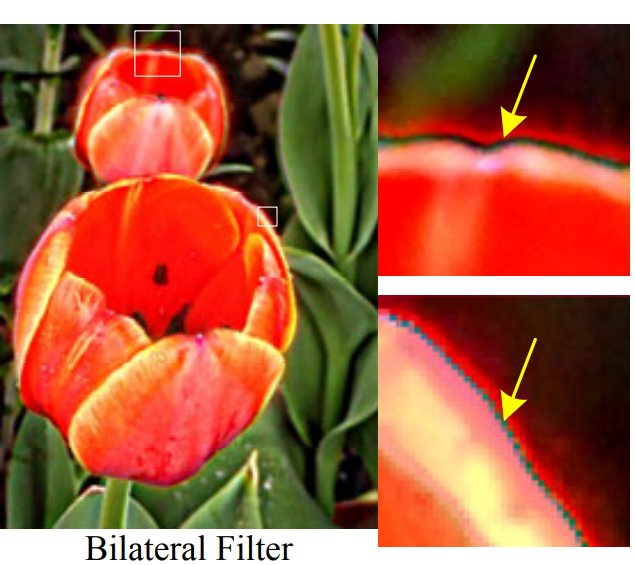
taken from paper of Guided Image Filtering .
Happens because:
We realize that the halo artifacts, that occur in detail enhancement, come from the weak discrimination between pixel pairs in the local window. In general, the simple intensity difference of the standard model is insufficient to determine which pixels should be smoothed and which detail- and edge-pixels should be preserved.
source:
@inproceedings{pham2012local,
  title={A local variance-based bilateral filtering for artifact-free detail-and edge-preserving smoothing},
  author={Pham, Cuong Cao and Ha, Synh Viet Uyen and Jeon, Jae Wook},
  booktitle={Advances in Image and Video Technology: 5th Pacific Rim Symposium, PSIVT 2011, Gwangju, South Korea, November 20-23, 2011, Proceedings, Part II 5},
  pages={60--70},
  year={2012},
  organization={Springer}
}