Nvidia Flip
% You need the following in your main .tex-file to get the flipped F in the title:
%\usepackage{mathtools} \usepackage{xspace} \newcommand{\FLIP}{\protect\reflectbox{F}LIP\xspace}

# @title     = "{{\FLIP:} {A} Difference Evaluator for Alternating Images}",

@article{Andersson2020,
  author    = {Pontus    Andersson and
               Jim Nilsson and
               Tomas Akenine{-}M{\"{o}}ller and
               Magnus Oskarsson and
               Kalle {\AA}str{\"{o}}m and
               Mark D. Fairchild},
  title     = {FLIP: A Difference Evaluator for Alternating Images},
  journal   = {Proceedings of the ACM on Computer Graphics and Interactive Techniques},
  volume    = {3},
  number    = {2},
  pages     = {15:1--15:23},
  year      = {2020},
}
Algorithm to detect differences in images in a magnitude that aims to be comparable to human perception.
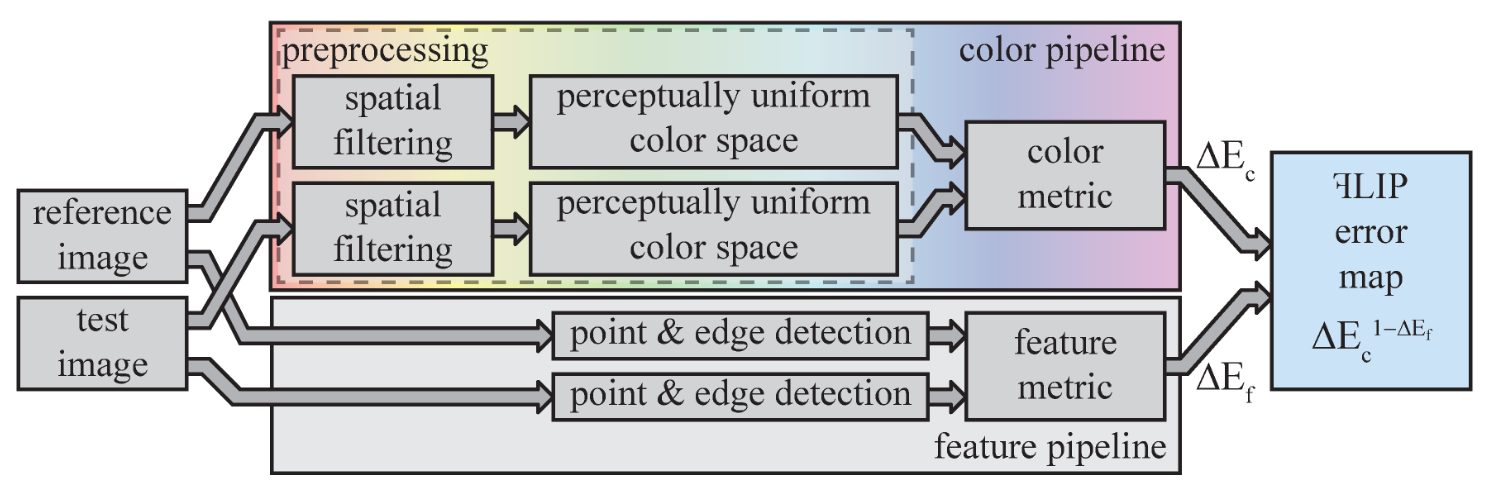
As an image comparison algorithm, FLIP carefully evaluates differences in color and edges based on, or inspired by, models of the human visual system. Developed mainly for rendering, it also pays attention to differences in point-like structures, such as fireflies, i.e., isolated pixels with colors that differ greatly from the color of their surroundings. In addition,F LIP is designed to neglect differences in details that the observer cannot perceive under given viewing conditions.
FLIP is a full-reference image difference algorithm, whose output is a new image indicating the magnitude of the perceived difference between two images at each pixel. Alternatively, for a more compact representation of the differences, the user can requestF LIP to pool the per-pixel differences down to a weighted histogram, or all the way down to a single value.
We provide improvements to each of these building blocks to obtain an algorithm that, ultimately, presents differences that agree well with how human observers perceive them.
We show that this is indeed the case via a user study, where alternating images, together with difference maps from multiple algorithms, were shown to subjects who were asked to rank the difference maps based on how well the maps agreed with what the subjects observed when looking at the alternating images.
Our user study shows that FLIP performs well for several image types in addition to rendered ones, including natural images and images generated by artificial neural networks.