Radiosity
@article{goral1984modeling,
  title={Modeling the interaction of light between diffuse surfaces},
  author={Goral, Cindy M and Torrance, Kenneth E and Greenberg, Donald P and Battaile, Bennett},
  journal={ACM SIGGRAPH computer graphics},
  volume={18},
  number={3},
  pages={213--222},
  year={1984},
  publisher={ACM New York, NY, USA}
}

with

- See Lambertian BRDF
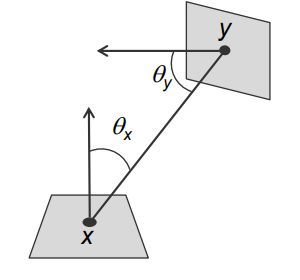
Nusselt-Analog #
-
For two patches in the radiosity method:
-
For all two points on the two surfaces:
-
The geometry factor accounting to the Area Foreshortening can be assumed as a constant.
Discrete Radiosity Equation #
<img src="/ltximg/radiosity_b33b28740c911682aeb0410c79f6ff76b6912d9c.svg" alt="radiosity_b33b28740c911682aeb0410c79f6ff76b6912d9c.svg" class="org-svg" />
with:
 = The average fraction of energy that leaves finite element i and
directly arrives at element j
= The average fraction of energy that leaves finite element i and
directly arrives at element j
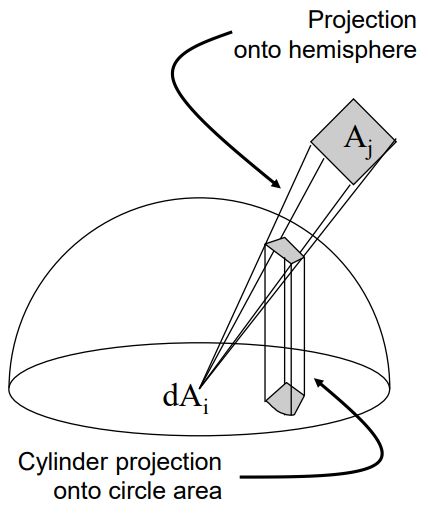
Form Factors #
Idea: Double Projection
Properties #
- Planar patch:

- Energy conservation:

- Reciprocity:

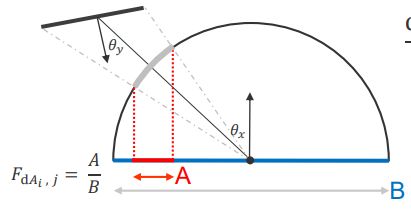
Computation #
Formular to compute the form factor to some Area  at
at  to
to  :
:

Hemicube Algorithm #
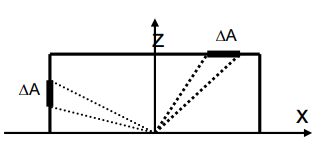
-
Use the Nusselt Analog
-
precompute formfactors for hemicube
-
When rendering, project other patches onto the cube (respect visibility)
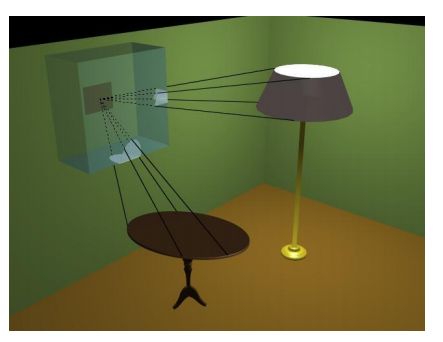
Using hardware acceleration #
- Put camera in the center of the hemicube
- Render cube maps
- Each fragment just writes some unique per patch ID, no color
- Standard depth test takes care of visibility
- After that, sum up the contributions of the objects by their ID
Rendering the scene #
- Render per patch radiosity values
- Color the vertices according to their neighboring patch colors and use Gouraud shading .
Comparison to raytracing #
- Raytracing is good at specular reflection and refraction, but bad at diffuse interactions
- Radiosity is good at diffuse lighting but bad at other stuff
Both methods are global, use them both at the same time!